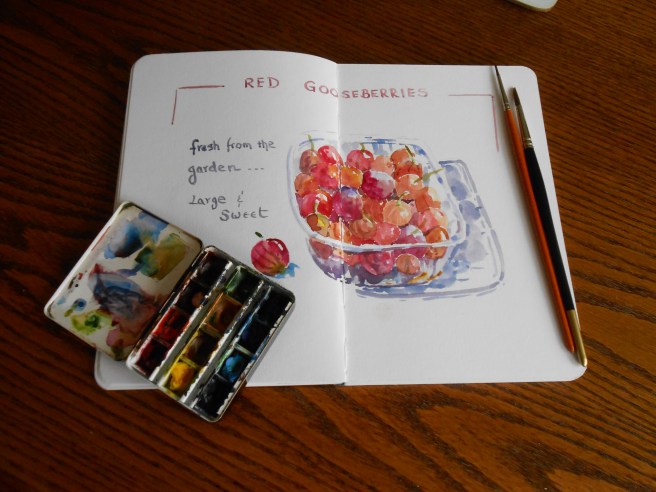
Lovely rich colours, some as dark as plums, our one bush has provided a good harvest this year.
Painted with new gamboge, permanent rose, permanent magenta and cobalt blue.
Lovely rich colours, some as dark as plums, our one bush has provided a good harvest this year.
Painted with new gamboge, permanent rose, permanent magenta and cobalt blue.
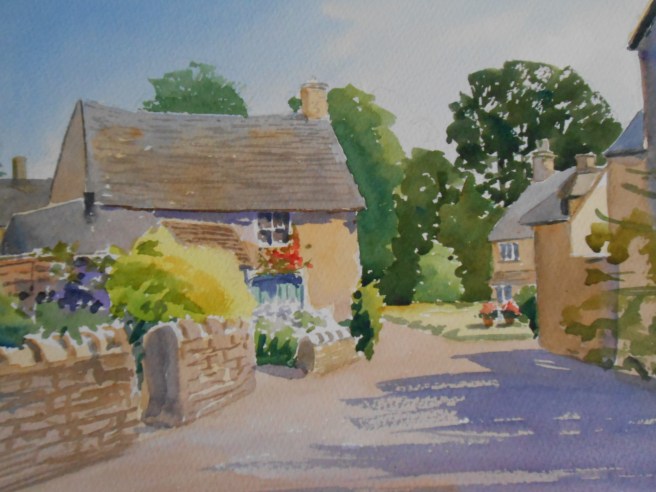
Only a step away from the main High Street lined with shops and places to eat, this pretty corner receives little notice from the many visitors to the village.
Whether you are at home or spending some time at a holiday destination, it is worth searching out the back streets and the less well-known places which can often present the sketcher with some charming views.
( Click on ‘Leave a comment’ at the top of this post to Like or Share or comment)
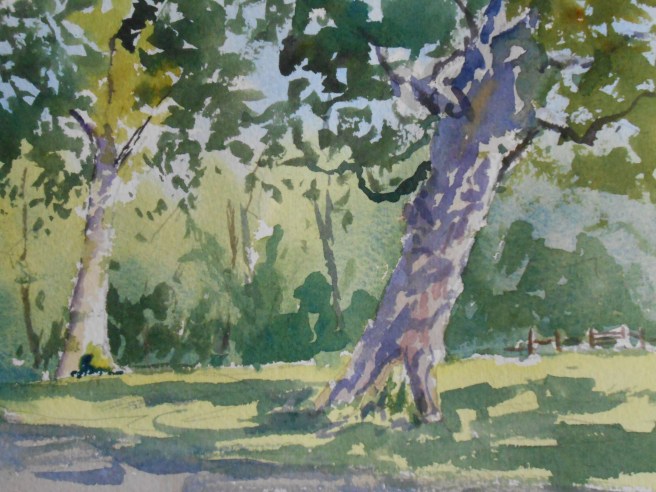
July has been declared World Watercolor Month to promote and connect the vast community of watercolourists all over the world.
Post any piece of art which uses watercolour or gouache on social media and tag it with #WorldWatercolorMonth to raise awareness of this and the charity The Dreaming Zebra Foundation which provides support so that children and young adults are given an equal opportunity to explore and develop their creativity. Reusable art and music supplies that would otherwise be discarded, along with new or unsold materials are donated by individuals and businesses and matched to recipients who have requested materials for arts education purposes in communities around the world.
Check out their website at World Watercolor Month.com
I am surprised at how many people are put off from sketching on location because of the amount of luggage they think they need. I even heard one person wondering how they were expected to carry a table into a field with them.
The answer ofcourse is that no-one expects them to travel with a furniture van.
I admit there are times when I choose to take larger sheets of paper and an easel with me, but that is by no means all the time. There are many different set ups and you need to find the right one for you.
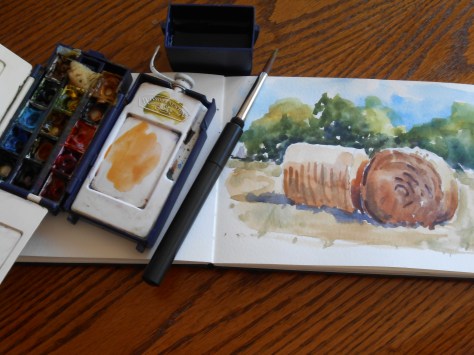
My basic small set up requires little more than a sketchbook, the one here is a Moleskine about 5.25 x 8.25 inches when closed which has a nice paper which readily accepts watercolour.
A Winsor & Newton Watercolour Field box holds 12 half-pans and has an integral water bottle and a water pot which clips onto the box. I fill the half pans with tube pigments.
Lastly, a travel brush or two. The one shown I have had so long that any writing on the side has long worn off but it is about size 6 or 8. The handle unscrews and protects the brush head when not in use. Many brush manufacturers have their own versions including Da Vinci, Escodia, Pro Arte and Rosemary & co to name a few.
The only other things I take with me are some sheets of kitchen paper and extra water. Oh, and a pencil or two !
I tend to stand, holding the sketch book and field box in one hand which leaves the other hand free to wield the brush. Otherwise I sit on the ground, find a bench or lean against a wall or a tree… That way I don’t have the inconvenience and extra weight of a chair or a stool. It takes a little experience and may not be for everyone but give it a try.
So, Keep it Light & Transportable !
Good luck with your sketching.
The summer weather couldn’t have come at a better time this year. Having spent some time out of necessity in the studio working on a commissioned painting and preparing for a workshop, I didn’t need much persuading when I heard reports of wall-to-wall sunshine..
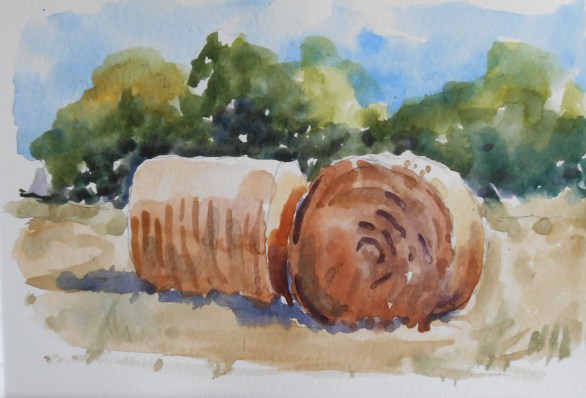
I have been keeping my eye on the surrounding landscape over the last few weeks watching for signs of poppies and hay bales in the fields. It won’t be long before we have a riot of colour. The sun has been a long time coming and the farmers have been despairing over their crops ever ripening, but now it seems everything is surging ahead.
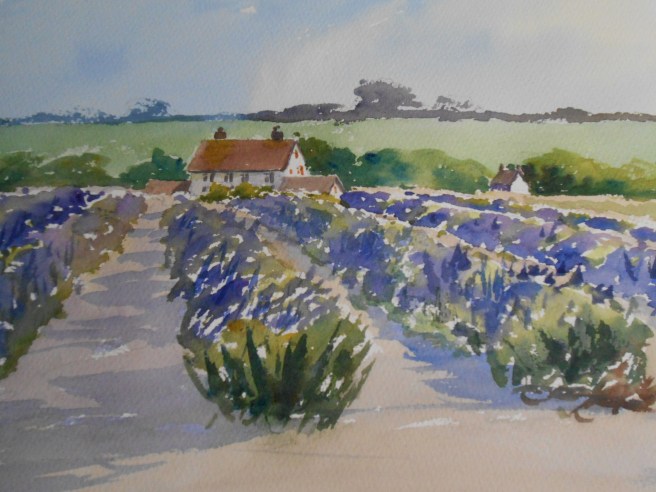
One of the most colourful places to visit is the Lavender farm at Snowshill. Field after field of the aromatic plant transporting you from the English Cotswolds to the French Mediterranean in an instant. If you haven’t seen it, it’s really worth a visit, especially now while the flowers are at their best.
And what a feast for the artist ! The day I visited, it was not too crowded. It is a magnet for photographers and those who just want to walk along the rows soaking up the atmosphere. There is plenty of space for everyone to do their own thing without being in anyone else’s way.
To sketch ‘en plein air’ out in the open, is one of the greatest joys as long as you don’t beat yourself up that what you produce may not be your best creation. For the serious painter it is a huge and important learning curve in studying the landscape and the effects of light. A never ending lesson. Whatever your level the experience and the emotions you have being there among the sights, sounds and smells lifts the spirits like nothing else.
So grab a sketchbook and have a go. Persuade a friend to accompany you if you like. They can always read a book if they are not inclined to play with paint.
And remember – Enjoy yourself !
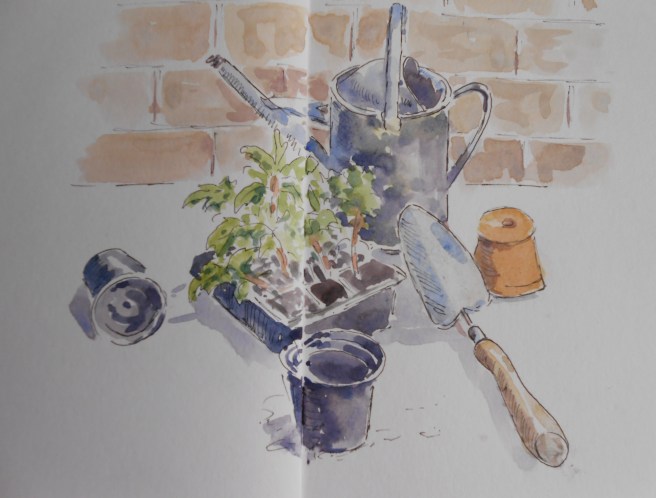
There comes a point in time when you can no longer use the weather as an excuse not to do something. Yesterday I wanted to to do some painting. I wanted to do some gardening. Most of all I wanted to dodge the rain showers.
Despite the cold I managed to do a bit of everything; weeding, potting on some tender green shoots which I hope one day will turn into tomatoes (should we have any sun), and grabbing a sketchbook to get something down before the next bout of rain.
Sometimes, snatching the moment and sketching what is there can be more rewarding than spending hours trying to find the ‘perfect’ composition or the ‘ideal’ landscape. They rarely turn out to be quite so perfect anyway!
I used a Stillman & Birn Beta series softbound A5 sketchbook.
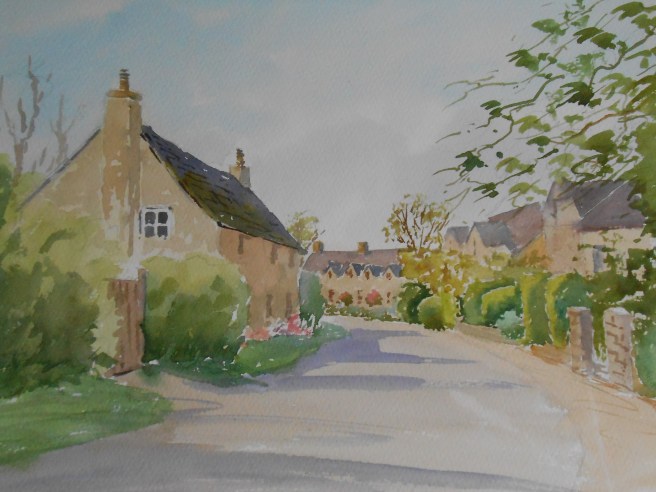
Many people remember Adlestrop, the name, thanks to a poem by Edward Thomas, a First World War writer. In 1914 Thomas was on a train which paused at the local station and jotted down a few lines about how absolutely nothing happened.
A lot of people read the poem at school, and are often surprised that Adlestrop is a real place. Yet here it is. Sitting quietly on the edge of Gloucestershire. Others may know of it through another writer, Jane Austen, who came here to visit her cousins, the Leighs.
Edward Thomas never alighted from his train, so would not have known the village, He did not survive the war and thus never returned. Jane Austen, who visited a great deal earlier, would probably still recognise it.
As in the poem, nothing much still happens here. Walking through it recently I met two other visitors. Apart from them the only sign of life was a postman buzzing around in his van. There must have been other visitors since Thomas wrote ‘No-one left and no-one came’ ?
There are still ‘cloudlets in the sky’ and blackbirds still sing in this corner of England, but alas the Station where Thomas paused is no longer. Only the nameplate remains, moved to the only bus stop in the village.
The day I was there, no-one left and no-one came by bus either.
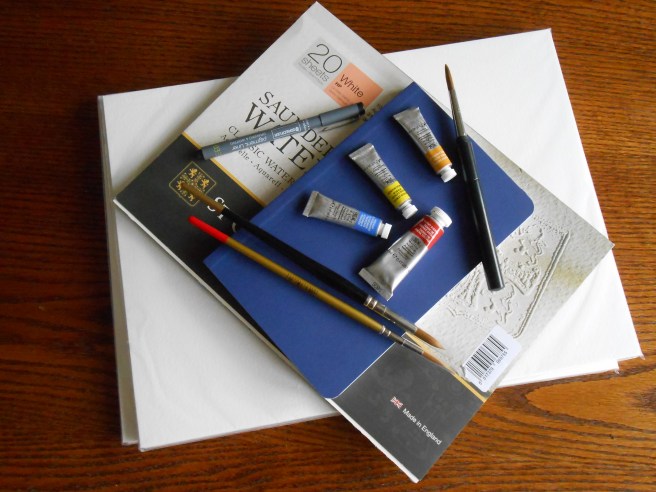
With the arrival of Spring, late as it may be (here in the UK we have had a long and very wet winter and may not be entirely rid of it yet), any artist who enjoys painting outside is chomping at the bit to get going; to be out in the midst of Nature, to feel the sun on their back (remember what that feels like?).
In the meantime it is a good idea to make sure you are fully prepared for the glorious season ahead and have a good stock of materials at hand.
Enough paper. I usually like to have loose sheets of at least 140lb watercolour paper of either Hot Press or NOT (Cold Press). A watercolour Block or two – they come in different sizes and while some people do not like them, I find they are convenient and manageable and lighter than having to carry easel and drawing boards around.
A sketchbook or two, again of various sizes. Whether you use cartridge paper or watercolour paper depends on the type of sketch you propose to do and how wet you like to work. Hardbound if you are happy to keep them as a journal or personal diary, ringbound if you want to detatch them at a later date to frame them. A pocket size , A5 and A4 are my most frequent choices for taking out and about as any larger becomes unwieldly and adds to the weight.
Make sure your brushes are in good condition. Perhaps now is a good time to treat yourself to a new one. Like most people, I have LOADS, and most of them are well past their best, but like the old friends they are, I hate to abandon them. It is good though to have one with a fine point rather than one with a ragged tip looking decidedly moth-eaten.
Make sure you have good quality pigments. I favour tubes from which I can top up my palette regularly as there is nothing worse than running out of a much needed pigment when you are miles from anywhere.
So sharpen up your pencils,replenish your ink pens and as soon as the temperature rises above freezing, you’ll be ready to grab your materials and set off in the knowledge you are fully prepared!
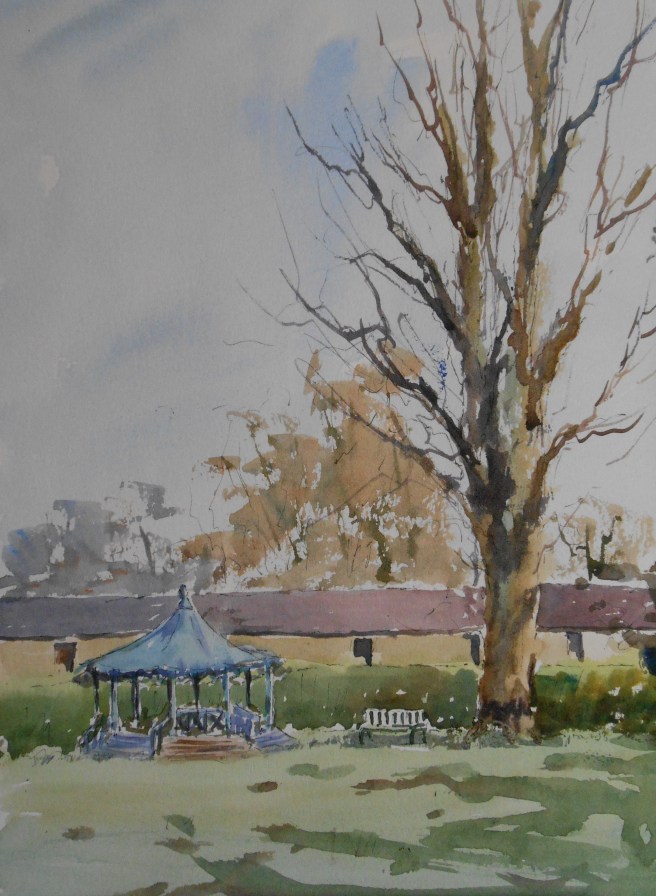
A rare thing happened in the Cotswolds today. We had wall-to-wall sunshine and it was actually WARM. No wet stuff! I had to go to Cirencester in the morning and while there I took the opportunity to sit and enjoy a moment in the peaceful green area of the Abbey Grounds behind the church of St John the Baptist.
Not only did I sit, but I sketched a view of the bandstand and the still wintery-looking tree close to it. I used a Saunders Waterford 140lb Hot Press block 12 x 9″
Unfortunately the good weather is forecast to disappear as rapidly as it came, but I would like to return here for longer later in the summer.
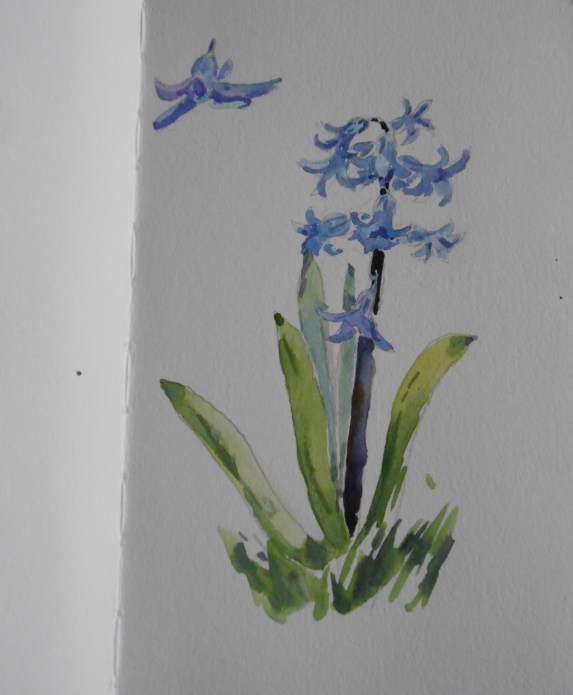
As it was far too wet to do any serious painting outside today, even from the comfort of the car, I was staring out of the window wondering if the rain would ever stop, when the Hyacinths in the garden caught my eye. I decided to try and sketch one through the window, and the rain drops.
I used mostly Cerulean Blue, French Ultramarine and Winsor Violet for the flowers and Winsor Lemon or New Gamboge and French Ultramarine for the leaves. I also dropped in some violet into the green where I wanted it dark.
Painted in a Stillman and Birn Beta series softback sketchbook.
 Graham Findlay Watercolours